
Herramientas de usuario
wiki2:oglmaths
¡Esta es una revisión vieja del documento!
Tabla de Contenidos
OpenGL Maths
Quaternions and gimbal lock
- The math used by the implementation of GLKMatrix4MakeLookAt() cannot produce a useful point of view that looks directly along the “up” vector. The limitation exists because when looking directly “up” or “down,” the math used by GLKMatrix4MakeLookAt() attempts to calculate the tangent of 90 degrees, which is mathematically undefined.
- Quaternions take advantage of 4D space to represent 3D angles.
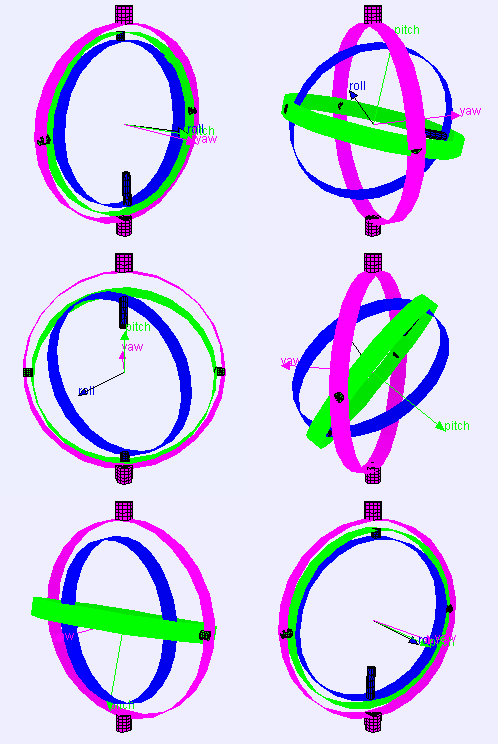
- Gimbal lock is the loss of one degree of freedom in a three-dimensional, three-gimbal mechanism that occurs when the axes of two of the three gimbals are driven into a parallel configuration, “locking” the system into rotation in a degenerate two-dimensional space.
- Gimbal with 3 axes of rotation. A set of three gimbals mounted together to allow three degrees of freedom: roll, pitch and yaw. When two gimbals rotate around the same axis, the system loses one degree of freedom.
Matrices
Coordenadas
Cartesianas
(x, y, z)
Polares
Las coordenadas polares o sistemas polares son un sistema de coordenadas bidimensional en el cual cada punto del plano se determina por una distancia y un ángulo, ampliamente utilizados en física y trigonometría.
Esféricas
El sistema de coordenadas esféricas se basa en la misma idea que las coordenadas polares y se utiliza para determinar la posición espacial de un punto mediante una distancia y dos ángulos. En consecuencia, un punto P queda representado por un conjunto de tres magnitudes: el radio r, el ángulo polar o colatitud φ y el azimut θ (r, phi, theta).
Figuras geométricas
Esfera
void renderSphere(float cx, float cy, float cz, float r, int p)
{
    float theta1 = 0.0, theta2 = 0.0, theta3 = 0.0;
    float ex = 0.0f, ey = 0.0f, ez = 0.0f;
    float px = 0.0f, py = 0.0f, pz = 0.0f;
    GLfloat vertices[p*6+6], normals[p*6+6], texCoords[p*4+4];

    if( r < 0 )
        r = -r;

    if( p < 0 )
        p = -p;

    for(int i = 0; i < p/2; ++i)
    {
        theta1 = i * (M_PI*2) / p - M_PI_2;
        theta2 = (i + 1) * (M_PI*2) / p - M_PI_2;

        for(int j = 0; j <= p; ++j)
        {
            theta3 = j * (M_PI*2) / p;

            ex = cosf(theta2) * cosf(theta3);
            ey = sinf(theta2);
            ez = cosf(theta2) * sinf(theta3);
            px = cx + r * ex;
            py = cy + r * ey;
            pz = cz + r * ez;

            vertices[(6*j)+(0%6)] = px;
            vertices[(6*j)+(1%6)] = py;
            vertices[(6*j)+(2%6)] = pz;

            normals[(6*j)+(0%6)] = ex;
            normals[(6*j)+(1%6)] = ey;
            normals[(6*j)+(2%6)] = ez;

            texCoords[(4*j)+(0%4)] = -(j/(float)p);
            texCoords[(4*j)+(1%4)] = 2*(i+1)/(float)p;


            ex = cosf(theta1) * cosf(theta3);
            ey = sinf(theta1);
            ez = cosf(theta1) * sinf(theta3);
            px = cx + r * ex;
            py = cy + r * ey;
            pz = cz + r * ez;

            vertices[(6*j)+(3%6)] = px;
            vertices[(6*j)+(4%6)] = py;
            vertices[(6*j)+(5%6)] = pz;

            normals[(6*j)+(3%6)] = ex;
            normals[(6*j)+(4%6)] = ey;
            normals[(6*j)+(5%6)] = ez;

            texCoords[(4*j)+(2%4)] = -(j/(float)p);
            texCoords[(4*j)+(3%4)] = 2*i/(float)p;
        }
        glVertexPointer(3, GL_FLOAT, 0, vertices);
        glNormalPointer(GL_FLOAT, 0, normals);
        glTexCoordPointer(2, GL_FLOAT, 0, texCoords);
        glDrawArrays(GL_TRIANGLE_STRIP, 0, (p+1)*2);
    }
}
Billboarding
wiki2/oglmaths.1448215090.txt.gz · Última modificación: 2020/05/09 09:24 (editor externo)
Herramientas de la página
Excepto donde se indique lo contrario, el contenido de este wiki esta bajo la siguiente licencia: CC Attribution-Noncommercial-Share Alike 4.0 International


